To your address
Delivery to your door, included in the price.
- Power supply
- A standard 120 V outlet
- Noise
- 22 dB: fine in a living space
- Energy
- 1.0 kWh a day
- Power a month
- $5.58 at $0.182 (US average)


Every new block is a fresh draw for the whole prize.
It is a lottery, not income. Odds are at today’s difficulty and change with it.
Price $443 Delivery included In stock
Every coin on the SHA-256 algorithm.
Bitcoin
BTC
Bitcoin Cash
BCH
Bitcoin SV
BSV
For home solo miners who want the most efficient Bitaxe and accept that the design is still marked as a prototype.
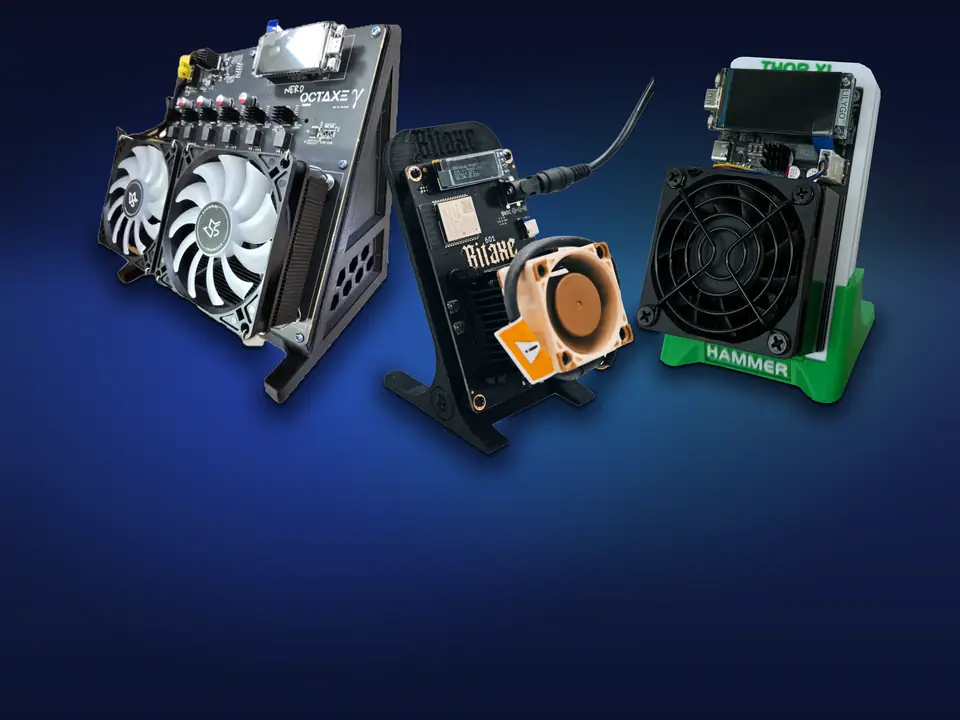
The Bitaxe Naja Duo 1201 is an open-source desktop Bitcoin miner with two BM1373 chips, believed to be the chip from the Antminer S23 series. Its design files are published under the CERN-OHL-S-2.0 licence, and the project itself still calls the design an untested prototype.
It makes 4.4 TH/s on SHA-256 at 42 W, about 9.5 J/TH. That is well below the 15.8 to 20 J/TH of the Gamma Duo and GT 801. The default settings are 327 MHz at 1,000 mV. It runs on 12 V DC through an XT30 connector, and a 12.4 V 10 A, 124 W supply is an option. Its fan is rated at 22.4 dB at full speed, which points to a very quiet device. It connects over 2.4 GHz Wi-Fi.
Compared with the GT 801, the Naja Duo roughly doubles the hashrate at the same power. On a solo pool it is a lottery: every block is a fresh draw for the whole reward.
42 W around the clock, 1.0 kWh a day.
Sized for a continuous load. An electrician confirms the wiring on site.
Need the exact packing list or a spare cord? Ask us before you order
Delivery to your door is in the price. Here is what it needs from the room.
Delivery to your door, included in the price.
Pay by Bank transfer Crypto
12 V DC through an XT30 connector. A 12.4 V 10 A, 124 W supply is available. The miner draws about 42 W.
Its fan is rated at 22.4 dB at full speed. That is the fan rating, not a measurement of the whole device.
Both draw about 42-43 W, but the Naja Duo makes 4.4 TH/s against 2.15 TH/s for the GT 801.
The open-source project still describes it as an untested prototype.
Yes. It works on every new block, 144 draws a day and over 52,000 a year, and a block pays the whole prize: 3.15 BTC (about $188,000). It is a lottery: at today’s difficulty the chance is about 1 in 4,200 a year. A year of draws uses about $27.23 of power at $0.074.
Yes, at our container facility in Texas. Hosting is priced by how many machines you host: 1–4 machines $0.078 per kWh plus $8 per machine a month; 5–9 machines $0.076 per kWh plus $6 per machine a month; 10–49 machines $0.074 per kWh, electricity only; 50+ machines by custom quote. For this machine, power at $0.074 per kWh comes to about $2.27 a month.
Yes. At checkout, choose delivery to our Texas facility instead of your address. We receive it, rack it and run it on your own pool account, so the coins go straight to your wallet.
It runs on a standard 120 V outlet at 22 dB, quiet enough for a room people use.
Same algorithm, nearest efficiency, same power price.
 Bitaxe Naja Duo 1201 4.4 TH/s
This machine |
 FutureBit Apollo III Full Node 8 TH/s |
FutureBit Apollo III Standard 8 TH/s
|
 Hammer Thor P2 6.6 TH/s |
Hammer Thor X1 2.5 TH/s
|
|
|---|---|---|---|---|---|
| Chance of a block a year | 1 in 4,200 | 1 in 2,300 | 1 in 2,300 | 1 in 2,800 | 1 in 7,300 |
| Price | $443 | $1,379 | $1,079 | $628 | $340 |
| Price per TH/s | $100.68 | $172.38 | $134.88 | $95.15 | $136.00 |
| Hashrate | 4.4 TH/s | 8 TH/s | 8 TH/s | 6.6 TH/s | 2.5 TH/s |
| Power | 42 W | 80 W | 80 W | 73 W | 26 W |
| Efficiency | 9.5 J/TH | 10 J/TH | 10 J/TH | 11 J/TH | 10.5 J/TH |
| Compare | Compare FutureBit Apollo III Full Node 8 TH/s | Compare FutureBit Apollo III Standard 8 TH/s | Compare Hammer Thor P2 6.6 TH/s | Compare Hammer Thor X1 2.5 TH/s |
 Air-cooled
3.15 BTC block prize
Chance 1 in 2,300 a year
 Air-cooled
3.15 BTC block prize
Chance 1 in 2,300 a year
 Air-cooled
3.15 BTC block prize
Chance 1 in 2,800 a year
 Air-cooled
3.15 BTC block prize
Chance 1 in 7,300 a year