
















Solo mining
Solo Bitcoin miner odds: what a small miner can expect
Solo Bitcoin miner odds by device, worked out at today's difficulty: chance per day and year, what a year of power costs, real wins and how to set one up.
Short answer
A solo Bitcoin miner keeps the whole block if it finds one, about 3.14 BTC in November 2026. A desk-size device gets about 144 draws a day, over 52,000 a year, for a few dollars of power a month. Small solo miners do win a few times a year worldwide. It is a lottery ticket, not income: with 1.2 TH/s the chance is about 1 in 15,300 a year.
- Chance per day at 1.2 TH/s
- 1 in 5.6 million
- Chance per day at 6 TH/s
- 1 in 1.1 million
- Chance per day at 270 TH/s
- 1 in 24,800
- Reward for one block, 24 Nov 2026
- 3.14 BTC
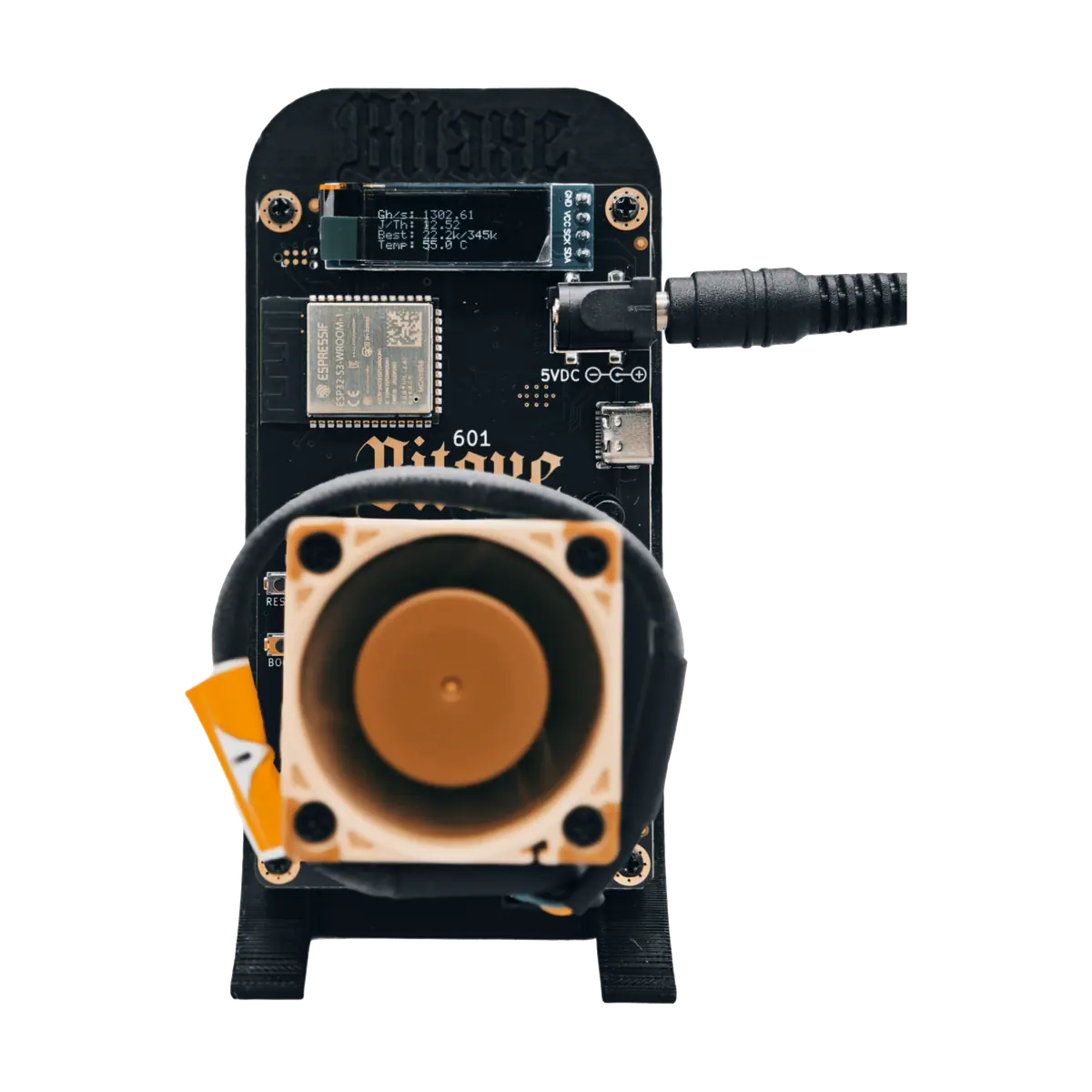
On 10 July 2026 a miner reported as a single Bitaxe, a palm-size device that draws under 20 watts, found Bitcoin block 957,382 and kept the whole reward of 3.138 BTC (see recent blocks). Stories like that are true. This post shows how a solo Bitcoin miner works, what the odds are for real devices, what a year of trying costs and how to set one up. If you only want the machines, see our solo and lottery miners, each listed with its odds.
How does a solo Bitcoin miner work?
Every miner does the same job: it hashes block headers and hopes for a result below the network's target. In a pool, thousands of machines share the work and every block is split between them. In solo mining you share with no one. If one of your hashes meets the target, the new coins and the fees of that block are yours. If not, the next block is a fresh draw about ten minutes later.
Each hash is an independent try. A Bitaxe hash has the same chance as a hash from the largest farm in Texas. The farm simply makes more of them. Every block is a fresh draw: a device plugged in this morning has the same chance on the next block as one that has run for years.
Over a very long time solo and pool mining pay about the same. What differs is the spread. A pool turns your hashrate into small regular payouts. Solo mining turns it into a chance at one very large sum.
What are the odds for each device?
These are machines from our catalog at the Bitcoin difficulty of 24 November 2026, which was 134.8 trillion (live figure).
| Device | Hashrate | Draws a year | Chance in a year | Prize |
|---|---|---|---|---|
| Bitaxe Gamma | 1.2 TH/s | over 52,000 | 1 in 15,300 | 3.14 BTC |
| Bitaxe GT 801 | 2.15 TH/s | over 52,000 | 1 in 8,500 | 3.14 BTC |
| NerdQAxe++ | 4.8 TH/s | over 52,000 | 1 in 3,800 | 3.14 BTC |
| Avalon Nano 3S | 6 TH/s | over 52,000 | 1 in 3,100 | 3.14 BTC |
| NerdOCTAXE Gamma | 9.6 TH/s | over 52,000 | 1 in 1,900 | 3.14 BTC |
| Hammer BC08 | 12 TH/s | over 52,000 | 1 in 1,500 | 3.14 BTC |
| Avalon Mini 3 | 37.5 TH/s | over 52,000 | 1 in 490 | 3.14 BTC |
| Antminer S21 XP | 270 TH/s | over 52,000 | 1 in 69 | 3.14 BTC |
Difficulty changes about every two weeks, and the odds with it. The solo mining odds calculator uses the current figure and takes any hashrate.
If 15,300 people each ran a Bitaxe for a year, about one of them would find a block (how the odds work); it can be any of them, on any day.
How are solo mining odds worked out?
You need two numbers: your hashrate and the network difficulty. Finding a block takes on average difficulty times 2 to the power of 32 hashes. Divide the hashes you do in a year by that number and you have your chance a year.
Here is the sum for a Bitaxe Gamma:
| Step | Figure |
|---|---|
| Difficulty | 134.8 trillion |
| Times 2 to the power of 32 | 4,294,967,296 |
| Hashes per block, on average | about 579 sextillion |
| Your speed | 1.2 TH/s, or 1.2 trillion hashes a second |
| Chance in a year | your hashes in a year divided by that: about 1 in 15,300 |
The odds calculator does this with the live difficulty. The quicker way is your share of the network. Network hashrate that day was about 1,056 EH/s, so a 1.2 TH/s device held roughly one part in 880 million, and there are about 144 chances a day. Small differences between the two methods come from how fast blocks are arriving that week.
Has a small solo miner ever found a block?
Yes, several times. In the twelve months to 24 November 2026, 28 of the 52,380 blocks found were credited to solo mining services (block tracker):
| Solo service | Blocks in twelve months |
|---|---|
| Solo CKPool | 15 |
| Public Pool | 6 |
| Braiins Solo | 5 |
| FutureBit Apollo Solo | 1 |
| SoloPool.com | 1 |
That is about 0.05% of all blocks. Two from this year:
- Block 957,382, 10 July 2026, Public Pool. Reported as one Bitaxe at about 1 TH/s. Its chance that year was about 1 in 18,200. It paid 3.138 BTC (recent blocks).
- Block 951,771, 31 May 2026, Braiins Solo. Reported as a home setup. It paid 3.140 BTC (recent blocks).
Some of those blocks come from a single small device; others from full-size machines, fleets or rented hashrate.
What does a year of solo mining cost?
Small devices are cheap to run, but not free. This is a year of electricity at the average US home price of $0.1816 per kWh, next to what the same hashrate would bring in from a pool at the network of 24 November 2026 (calculator).
| Device | Price | Power | Power, a year | Income, a year |
|---|---|---|---|---|
| Bitaxe GT 801 | $157 | 43 W | $68 | $22 |
| NerdQAxe++ | $211 | 76 W | $121 | $49 |
| Avalon Nano 3S | $238 | 140 W | $223 | $62 |
| NerdOCTAXE Gamma | $251 | 180 W | $287 | $99 |
| Hammer BC08 | $481 | 210 W | $334 | $124 |
| Avalon Mini 3 | $779 | 800 W | $1,274 | $386 |
Change the price and the hashrate in the mining calculator for your own case.
Income here means pool income before power. The last two columns show what a year of taking part costs. At that power price you pay a little for the draw, the fun, the learning or the heat, which is why people run them. If the heat replaces another electric heater you would have used anyway, that part of the power is not lost, which is why the heater models are popular.
Solo or pool: which should you choose?
| Solo | Pool | |
|---|---|---|
| What you get | Nothing, or a whole block | A small payout, often |
| Expected value over a very long time | About the same, minus a small fee | About the same, minus the pool fee |
| Fee on income | 2% of a block on Solo CKPool | Often 1% to 4% |
| Needs | Any hashrate | Enough hashrate to reach the smallest payout |
| Suits | Desk devices, curiosity, gifts, learning | Full-size miners and anyone who counts on income |
Fees and payout rules for each are on Bitcoin mining pools.
For a desk device, solo costs almost nothing compared with a pool, and it plays for the whole block. A full-size miner is the opposite. An Antminer S21 XP brings in about $7.61 a day before power in a pool (calculator). Running it solo swaps that for a 1 in 69 chance a year, with the power bill arriving every month.
Some people split the difference: full-size machines on a pool, one small device solo.
What does "best share" or "best difficulty" mean?
Most devices show the best result they have found so far. It tells you how close you came. To find a block, one share has to reach the network difficulty, 134.8 trillion in November 2026. A 1.2 TH/s device running for a year would expect its best share to be around 8.8 billion (the sum uses the same difficulty). It is a record to beat for the fun of it; the next block is a fresh draw whatever the record.
How do you set up a solo Bitcoin miner?
- Get a Bitcoin address you control. A reward of this size belongs in a hardware wallet with its seed phrase written on paper.
- Power the device with the supply it came with. Bitaxe boards need the exact voltage for the model: the wrong supply can destroy the board at once.
- Join its Wi-Fi. The first time, the device opens its own network. Connect to it, choose your home Wi-Fi and save.
- Open its page at the address shown on the screen.
- Enter a solo pool. For Solo CKPool the server is
stratum.ckpool.organd the port is 3333. Other solo services are listed under Bitcoin pools. - Use your Bitcoin address as the username. Add a dot and a name to tell devices apart. The password can be anything.
- Check the address twice. If it is wrong, so is the payout.
- Wait. Very small devices may not show up in a pool's statistics at first, because the pool starts with a difficulty they rarely reach. They are still mining.
- Keep it cool. Dust the fan, and lower the frequency if the chip runs hot. Overclocking adds a few percent to odds that stay tiny.
Choose from our solo and lottery miners: chip count sets the hashrate, and the hashrate sets the odds.
Do you need your own Bitcoin node?
No. A solo service builds the block for you and pays the reward straight to your address in that block, so it never holds your coins. Running your own node with your own solo server removes the fee and the dependency, and lets you choose which transactions go in. It needs a small computer with a large drive and a few evenings. Some devices, such as the FutureBit Apollo models, have the node built in.
Are the odds better on other coins?
The same SHA-256 devices can mine Bitcoin Cash, where far fewer machines compete. On 22 November 2026 its difficulty was about 273 times lower than Bitcoin's, so a block is 273 times more likely. But a block there paid 3.125 BCH, worth about $610, and the odds calculator covers both coins. The expected value ends up in the same range. You are choosing between a huge prize and a smaller one with better odds.
Who should run a solo miner?
Run one if you enjoy the idea, want to learn how mining works on real hardware, or want a quiet device that secures the network and might, against long odds, change your year. Do not run one to make money, do not buy a second one to double a chance that stays close to zero, and do not trust anyone who sells a "solo mining plan" with a promised result. If you want steady income per day, read how to mine Bitcoin and use a full-size machine in a pool.
Common questions
Can you really find a Bitcoin block with a small solo miner?
Yes. Block 957,382 in July 2026 was reported as a single Bitaxe at about 1 TH/s. It happens a few times a year worldwide, among a very large number of devices.
What are the odds of solo mining a Bitcoin block?
At November 2026 difficulty, about 1 in 15,300 a year for 1.2 TH/s, 1 in 3,100 for 6 TH/s and 1 in 69 for a 270 TH/s full-size miner.
How much does a solo miner win if it finds a block?
The new coins plus the fees in that block, about 3.14 BTC in November 2026. A solo service keeps a small fee, 2% on Solo CKPool. Everything else goes to your own address.
How do I calculate my solo mining odds?
Divide a year of your hashes by difficulty times 4,294,967,296 to get the chance a year. Our solo mining odds calculator does it with the live difficulty.
Is solo mining worth it?
For the chance and the hobby, yes: a desk device plays every block for a few dollars of power a month. It is a lottery, not income.
Which is the best solo Bitcoin miner?
The one with the most hashrate for the power and noise you accept. Desk devices with several chips reach 5 to 12 TH/s and stay quiet, and heater models reach 37.5 TH/s and replace a room heater.
Does a solo miner's chance improve the longer it runs?
No. Every hash is a new draw. Running longer gives you more draws, but past failures do not bring the next one closer.
Does lottery mining use a lot of electricity?
A single-chip device uses 15 to 45 watts, less than a light fitting. Multi-chip models use 75 to 210 watts and heater models up to about 1,500 watts.
Written by Hardware Desk
Reviews, comparisons and buying guides