
















Getting started
How to mine Bitcoin
How to mine Bitcoin step by step: pick an ASIC miner, plan the power, join a pool and set it up, with income per day worked out at four power prices.
Short answer
To mine Bitcoin you run an ASIC miner built for SHA-256, power it from a 220 to 240 V circuit, connect it to a mining pool and have the pool pay your own wallet. What you keep each day depends mostly on two numbers: the price you pay for electricity and how efficient the machine is.
- Bitcoin network hashrate, 24 Nov 2026
- 1,056 EH/s
- New coins per block
- 3.125 BTC
- Antminer S23, mined per day
- 0.000149 BTC
- Antminer S23 earns nothing above, per kWh
- $0.107
Anyone can mine Bitcoin, and the power price decides how much of it you keep. This guide takes you from how mining works to a running machine: what to buy, what it costs, what it brings in per day at different power prices, how to set it up and how to keep it running. If you already know the basics, go straight to our Bitcoin miners, where every machine shows its income per day.
How to mine Bitcoin in six steps
- Find your electricity price. Take the total on a recent bill and divide it by the kWh used. That one number decides most of what follows.
- Check the income. Put a machine and your price into the mining calculator and read the income per day after power.
- Decide where it runs. At home you need the right circuit and space for noise and heat. In a hosting facility someone else provides both.
- Choose the machine. Compare efficiency first, then hashrate, then price.
- Open a pool account and a wallet you control. The pool pays the wallet directly.
- Connect, configure and watch it. Enter the pool details in the miner's web page, then check hashrate and temperature for the first day.
The rest of the guide explains each step, with the figures behind it.
How does Bitcoin mining actually work?
Bitcoin groups transactions into blocks. To add a block, a miner must find a block header whose SHA-256 hash is lower than a target set by the network. There is no formula for it. Machines change a number in the header, hash it, check the result and try again, trillions of times a second. The first to find a valid hash sends the block to the network, and everyone else can check it instantly. That is proof of work.
Three rules shape what a miner earns:
- The block reward. Each block pays its finder 3.125 BTC in new coins plus the fees of its transactions. The new-coin part halves every 210,000 blocks, and the next halving comes at block 1,050,000, expected in 2028.
- The ten-minute target. The network aims for one block about every ten minutes, or 144 a day.
- The difficulty adjustment. Every 2,016 blocks, roughly two weeks, the target is reset so that blocks keep arriving at that pace (the calculator uses the current value). When machines join, difficulty rises; when they leave, it eases, and each machine's share grows.
This is why mining income moves even when nothing changes on your side. On 24 November 2026 the network ran at about 1,056 EH/s and the next adjustment was due around 27 November 2026; the calculator uses it the day it happens (check today's figure).
Can you mine Bitcoin on a PC, laptop or phone?
Bitcoin is mined by ASICs, which do far more work per watt than a computer. Graphics cards and processors were left behind more than ten years ago by ASICs, chips that do nothing except SHA-256. A phone app that claims to mine Bitcoin either shows adverts, rents hashrate from somewhere else or is a scam. If someone offers free Bitcoin mining, ask who pays for the electricity.
A small ASIC on a desk is a different matter. It will not pay a bill, but it does real work and gives you a tiny chance at a whole block. We cover that separately in solo mining odds.
What you need to mine Bitcoin
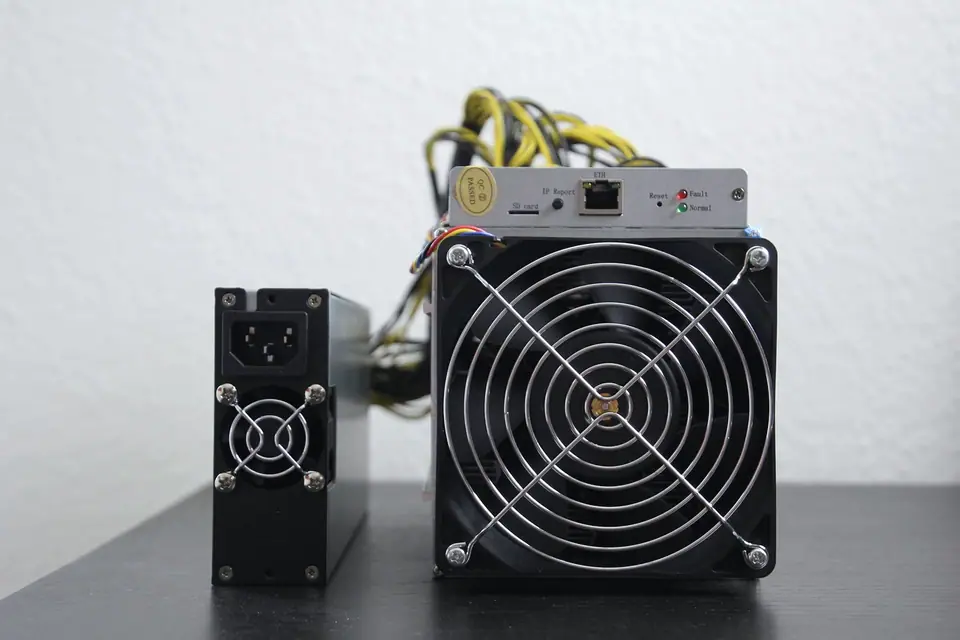
- An ASIC miner for SHA-256. Two numbers matter: hashrate in TH/s, which is how much work it does, and efficiency in J/TH, which is how much electricity each unit of work costs. Lower J/TH is better.
- A suitable circuit. Full-size miners draw more than three kilowatts without a break and run on 220 to 240 V. Our power setup guide covers breakers, plugs and cables.
- Airflow or a cooling loop. All the electricity a miner uses leaves it as heat. Full-size air-cooled machines are about as loud as a vacuum cleaner and need a way to push hot air outside. Hydro and immersion models are far quieter but need water or fluid, pumps and a dry cooler.
- A wired internet connection. Data use is small. A steady cable matters more than speed, because a miner that loses its pool stops earning.
- A pool account. One account, and one worker name per machine.
- A wallet you control. Write the seed phrase on paper, keep it offline and send a small test payout before you rely on it.
Which miner should a beginner choose?
Match the machine to the place it will live. These are six machines from our catalog, from desk size to hydro, with our prices on 24 November 2026. Prices include delivery and exclude VAT.
| Machine | Hashrate | Power | Efficiency | Price | Where it fits |
|---|---|---|---|---|---|
| Avalon Nano 3S | 6 TH/s | 140 W | 23.3 J/TH | $238 | A desk; runs from a normal socket |
| Avalon Q | 90 TH/s | 1,674 W | 18.6 J/TH | $1,269 | A home; a 20 A circuit at 120 V, or 240 V |
| WhatsMiner M60S | 186 TH/s | 3,441 W | 18.5 J/TH | $1,926 | A garage or facility with cheap power |
| Antminer S21 XP | 270 TH/s | 3,645 W | 13.5 J/TH | $5,508 | A dedicated circuit or a facility |
| Antminer S23 | 318 TH/s | 3,498 W | 11 J/TH | $6,938 | A dedicated circuit or a facility |
| Antminer S23 Hyd | 580 TH/s | 5,510 W | 9.5 J/TH | $12,143 | Three-phase power and a water loop |
Current prices and stock for each are on the Bitcoin miners page.
The common mistake is buying by price per terahash. The M60S costs less than a third of an S23, but uses almost the same electricity for a little over half the hashrate. With low-cost power the older machine is good value; with a higher price choose the efficient one.
What does a Bitcoin miner earn per day?
Income per day after power is the machine's share of the day's block rewards minus its electricity. With Bitcoin at $60,143 and the network of 24 November 2026, one machine came out like this in the calculator:
| Machine | Before power | At $0.074 | At $0.100 | At $0.1816 | Earns on power up to |
|---|---|---|---|---|---|
| WhatsMiner M60S | $5.24 | −$0.87 | −$3.02 | −$9.76 | $0.063 |
| Antminer S21 XP | $7.61 | $1.14 | −$1.14 | −$8.28 | $0.087 |
| Antminer S23 | $8.96 | $2.75 | $0.57 | −$6.28 | $0.107 |
| Antminer S23 Hyd | $16.35 | $6.56 | $3.12 | −$7.67 | $0.124 |
Power prices are per kWh: $0.074 is our hosting rate from 10 machines and $0.1816 the average US home price. Pool fees are left out and the cost of the hardware is not included. The mining calculator gives the same view with today's figures and your own price.
Read the last column first. Each machine earns on power up to that price. The average US household price is above it, which is why people place machines where power costs less.
Two checks keep you honest:
- Use the price you really pay. Delivery charges and taxes count. The rate on an advert often leaves them out.
- Leave room for difficulty. If a machine clears its power cost by a few cents today, one large adjustment can wipe that out.
How much bitcoin does one machine mine?
It depends on your share of the network. On 24 November 2026 a terahash running all day brought in about 0.00000047 BTC, fees included, so a single Antminer S23 made about 0.000149 BTC a day (the calculator has today's number). At that pace:
| Machines | BTC per day | Time to one BTC |
|---|---|---|
| 1 Antminer S23 | 0.000149 BTC | about 18 years |
| 10 Antminer S23 | 0.00149 BTC | about 22 months |
| 50 Antminer S23 | 0.00745 BTC | about 134 days |
| 100 Antminer S23 | 0.0149 BTC | about 67 days |
These times assume the difficulty and fees of that day. Difficulty has risen in most years and the halving cuts the new coins in half, so treat them as a sense of scale and use the calculator for a current reading.
Mining at home or in a hosting facility?
Home mining suits people with cheap power, a garage or outbuilding and some patience for wiring and noise. Hosting suits everyone else, and anyone who wants more than two or three machines.
| Mining at home | Hosting in our facility | |
|---|---|---|
| Power price | Your own bill | A set rate per kWh by number of machines |
| Circuit | You pay an electrician to install it | Already in place |
| Noise and heat | In your building | In the facility |
| Repairs | You diagnose and ship parts | Technicians on site |
| Coins | Paid to your wallet | Paid to your wallet |
Here is the difference for one Antminer S23 over a month of 730 hours. It uses 84 kWh a day, 2,554 kWh in all. At the average US home price of $0.1816 that is $463.72 of electricity. Hosted with us at the 1 to 4 machine rate of $0.078 plus a standing fee of $8 a month, it is $207.18. From 10 machines the rate is $0.074 with no standing fee, and hosting pricing shows every step.
How do you set up a Bitcoin miner?
- Unpack and look. Check for shipping damage, loose screws and unplugged cables. Photograph the serial label.
- Connect power last. Plug in the network cable first, then the power cord, fully seated, on its own circuit.
- Find the miner's address. Your router lists it as a new device, or use the maker's IP finder.
- Log in and change the password. Open that address in a browser on the same network. The default login is in the manual, and our setup pages list the power and network details of each model.
- Enter the pool. Paste the stratum address for your region, your worker name and any password. Add a second and third pool as backups.
- Choose a power mode. Start in the normal mode. Try low-power modes later if your electricity is dear.
- Save and wait. Give the miner time to tune itself before you judge the speed; a fresh start takes several minutes.
- Compare. After an hour, the pool's reading should be close to the rated hashrate. Pools measure it from submitted shares, so short readings jump around; judge it over a day.
How do you choose a mining pool?
A pool combines many machines, finds blocks regularly and splits each one by the work submitted. Four things differ between pools: how they pay, the fee, the smallest payout and whether they ask for identity documents.
| Pool | How it pays | Fee | Smallest payout |
|---|---|---|---|
| Braiins Pool | FPPS | 2.5% | 0.0002 BTC |
| F2Pool | FPPS or PPLNS | 4% or 2% | 0.005 BTC |
| OCEAN | TIDES | 2% | 0.01048576 BTC |
| EMCD | FPPS | 4% | 0.0001 BTC |
FPPS pays a fixed amount for every share, whatever the pool's luck. PPLNS and TIDES pay from blocks the pool really finds, so income varies more. For one or two machines the smallest payout matters: at 0.000149 BTC a day, an S23 needs about a month to reach 0.005 BTC. Compare the full list, with payout rules, on Bitcoin mining pools.
What goes wrong, and what beginners miss
- Heat. Hot air that loops back into the intake makes a miner slow down or shut off. Separate intake and exhaust.
- Power problems. Loose plugs, shared circuits and thin cords cause many early faults.
- Uptime. A machine that is off one day in ten loses a tenth of its income.
- Dust and fans. Clean filters and fans on a schedule; fans are usually the first part to wear.
- Fake sellers and cloud offers. No one can promise a fixed daily return, because the network does not.
- Tax records. In many countries mined coins count as income on the day you receive them. In the US, the IRS treats them that way. Save each payout with its date and value.
Who should mine Bitcoin, and who should not?
Mining suits people whose power price sits well under the last column of the income table, people who can use the heat, and people who want equipment they own and can place in a facility. It does not suit anyone who needs a fixed monthly income, or who pays a high household tariff and has nowhere else to put the machine. In that case hosting, or not mining at all, is the better answer.
What one Antminer S23 leaves a day after power
- Your power at $0.060 per kWh +$3.92 a day
- Hosted with us, $0.074 per kWh +$2.75 a day
- Your power at $0.100 per kWh +$0.57 a day
- Your power at $0.182 per kWh −$6.28 a day, a loss
Common questions
Can I mine Bitcoin for free?
No. Every hash costs electricity, so someone pays. Offers of free Bitcoin mining usually show adverts, collect your data or never pay out.
How much does it cost to start mining Bitcoin?
The machine, the circuit and the monthly power. A desk miner starts at $238 and runs from a normal socket. Older full-size models start under a thousand dollars and the most efficient air-cooled ones cost about seven thousand. At home you add an electrician for a 220 to 240 V circuit. Our prices include delivery.
How much bitcoin does one miner make a day?
An Antminer S23 of 318 TH/s made about 0.000149 BTC a day at November 2026 difficulty, fees included. One whole coin would take it about 18 years, and a hundred of them about 67 days.
Is Bitcoin mining legal?
In most countries, yes, including the United States and most of Europe. Some countries ban or restrict it, and local rules on electrical work, noise and zoning still apply. Check the rules where the machine will run.
Do I need a mining pool?
For steady income, yes. A pool pays small amounts often; alone, a machine plays every block for the whole reward.
How much electricity does a Bitcoin miner use?
A 3,498 W machine uses about 84 kWh a day, or 2,554 kWh in a month of 730 hours. That is more than many whole homes use.
Can I mine Bitcoin at home?
Yes, if you have a 220 to 240 V circuit, space for the noise and heat and a power price the machine can clear. Smaller home models run from a normal socket and make less noise.
Do I need special software to mine Bitcoin?
No. A modern ASIC has its own firmware and web page, and you enter the pool details there. Extra software is for people running many machines.
Written by Support Desk
Setup, fixes and warranty claims



